TCDA advocates inclusive digital finance to transform Ghana’s oil palm sector
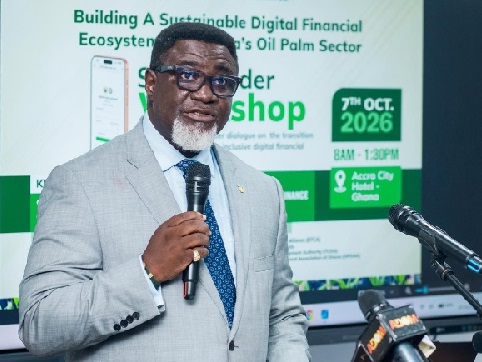
The Chief Executive Officer of the Tree Crops Development Authority (TCDA), Dr Andy Osei Okrah has called for an inclusive digital financial ecosystem to improve access to finance, enhance transparency and strengthen the competitiveness of Ghana’s oil palm industry.
He said digitalisation must go beyond replacing cash payments with mobile money transfers and bank transactions to enable farmers and other value chain actors to access savings, credit, insurance and other financial services.
Dr Okrah made the call at a stakeholder workshop on “Building a Sustainable Digital Financial Ecosystem for Ghana’s Oil Palm Sector” in Accra on Wednesday, October 7, 2026.
The workshop was hosted by the Better Than Cash Alliance (BTCA), in collaboration with the TCDA, the Oil Palm Development Association of Ghana (OPDAG) and the United Nations Development Programme (UNDP)-Ghana.
He explained that although digital payments could help farmers build financial transaction histories and improve their access to credit, the benefits would remain limited without reliable connectivity, accessible financial services and appropriate digital infrastructure.
According to him, the oil palm sector has significant potential to drive industrialisation, create jobs, promote rural development, reduce imports and increase exports.
He cited the government’s planned $500 million oil palm development finance facility under the National Policy on Integrated Oil Palm Development 2026–2032 as a significant commitment to unlocking the sector’s potential.
However, he stressed that financing alone would not transform the industry without systems that enable capital, technology, information and financial services to reach farmers and other value chain participants efficiently.
Dr Okrah also underscored the importance of inclusion, particularly for women smallholder farmers, young people and communities with limited digital literacy or weak connectivity.
He urged financial institutions to develop products suited to agricultural cash flows, while fintech companies and payment service providers should offer affordable, secure, interoperable and user-friendly solutions. Mobile network operators, oil palm companies, processors, aggregators and farmer organisations were also encouraged to support the digitalisation drive.
“Our vision is not simply an oil palm sector where payments are digital. Our vision is an oil palm sector where digitalisation creates opportunity, where farmers can build financial histories, access finance, protect themselves against risk, participate more effectively in markets and share fully in the growth of the industry,” he said.
He further called for strong safeguards against fraud, protection of personal data and effective mechanisms for addressing customer complaints to build trust in digital financial services.
The TCDA chief executive said the workshop should lead to practical interventions, including pilot projects in selected oil palm-producing communities, to test and scale solutions suited to the sector’s operational needs.
He reaffirmed the Authority’s readiness to collaborate with the Better Than Cash Alliance and other stakeholders to advance the initiative, stressing that the ultimate goal was to ensure digitalisation translated into genuine financial inclusion and economic empowerment.
Dr Okrah urged stakeholders to prioritise coordination, innovation and action, adding that digital financial solutions must reach the last mile and ensure that no farmer, woman or community was left behind.
Bridging palm oil supply gap
The President of the Oil Palm Development Association of Ghana (OPDAG), Paul Amaning called for inclusive digital financial services and improved access to affordable credit to boost local palm oil production and strengthen the competitiveness of Ghana’s oil palm industry.
He said Ghana produces approximately 250,000 metric tonnes of crude palm oil annually against an estimated demand of 400,000 metric tonnes, leaving a supply gap of about 150,000 metric tonnes.
Mr Amaning said the industry had significant potential to contribute to employment, livelihoods and economic development, with an estimated 360,000 hectares under cultivation and approximately 631,000 people supported by the sector.
He described the proposed $500 million oil palm development financing facility as an opportunity to address production challenges, but stressed that funding must be accessible to businesses across the value chain, particularly smallholder farmers, aggregators and artisanal processors.
He noted that many small-scale processors contributed significantly to local palm oil production and rural employment but continued to face difficulties accessing affordable finance, modern equipment and formal business support.
According to him, digital financial services could improve payment security, record-keeping and transparency while creating opportunities for value chain participants to access savings, credit, insurance and other financial products.
However, he cautioned that digitalisation must go beyond transferring money electronically and be supported by reliable network connectivity, affordable transaction charges, accessible payment agents, interoperable systems, consumer protection and practical education.
He also emphasised the need to ensure that women, young people, smallholder farmers and informal businesses were not excluded from the transition.
Mr Amaning said reliable digital transaction records could help financial institutions better understand businesses in the sector and make more informed lending decisions, although such records alone would not guarantee access to credit.
He called for stronger collaboration among government agencies, financial institutions, fintech companies, mobile network operators, mills, buyers and industry associations to develop solutions tailored to the sector’s needs.