Influence peaceful Homowo festivals - Deputy Minister urges Greater Accra queenmothers
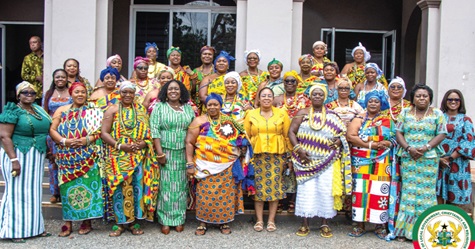
The Deputy Minister of Local Government, Chieftaincy and Religious Affairs, Rita Naa Odoley Sowah, has called on queenmothers in the Greater Accra Region to use their influence and positions to broker peace to ensure that the annual Homowo festival is devoid of violence and loss of life.
She said the violence, disunity and tensions that often characterised the celebration of the annual festival by the Ga people were inimical to peaceful coexistence and national development.
“During last year's Homowo festivities, six lives were tragically lost, three in Teshie and three in the Sowutuom-Anyaa area.
These were not merely statistics; they were sons, daughters, brothers, sisters, parents and members of families and communities. We must, therefore, do everything within our power to ensure that such unfortunate incidents do not occur again,” Ms Odoley Sowah said.
The Deputy Regional Minister, who made the call at a meeting with queenmothers at the Greater Accra Regional House of Chiefs (GARHC) last Wednesday, said that no festival, disagreement or misunderstanding was worth the loss of a human life.
She emphasised that where disagreements arose, they must be addressed through dialogue, mediation and the established traditional and lawful mechanisms.
“We must reject provocation, vigilantism, the use of weapons, inflammatory public statements and any conduct capable of escalating tensions,” she stressed.
Meeting
The working visit by the Deputy Regional Minister formed part of the government's agenda to strengthen collaboration with the traditional authorities, including queenmothers, to promote decentralisation and national development.
Present at the meeting were the Greater Accra Regional Minister, Linda Obenewaa Akweley Ocloo; the President of the Greater Accra Regional House of Chiefs, Oboade Notse King Professor Odaifio Welentsi III; the President of the Greater Accra Queen Mothers Association, Naa Amponsah Dokua III, and representatives from the various traditional councils within the Greater Accra Region.
The two sides discussed a number of issues — including the role of queenmothers in Ghana's development and the challenges in the performance of the role — during the meeting with the queenmothers.
They also deliberated on how to collectively ensure the peaceful, orderly and dignified celebration of the Homowo Festival across the Greater Accra Region.
The queenmothers also spoke about the need for peace and unity in the Greater Accra Region, especially during the celebration of Homowo.
They also touched on the issue of land disputes and the need to put in place systems to ensure effective land management in the region.
Collective responsibility
The Deputy Regional Minister emphasised that the responsibility for a peaceful Homowo did not rest on government or the security agencies alone but that it was a collective responsibility involving traditional authorities, queenmothers, metropolitan, municipal and district assemblies (MMDAs), religious leaders, community leaders, youth organisations and other stakeholders.
“I, therefore, urge queenmothers to work closely with chiefs, traditional councils, MMDAs, religious leaders, youth groups, community organisations and security agencies. In doing this, early warning and early response must become a central part of our approach to conflict prevention,” she added.
Inclusion
While giving a firm assurance of their readiness to work for a peaceful celebration of the Homowo festival, the queenmothers called for their inclusion in decision-making, particularly at all traditional councils.
Naa Dokua stressed that the sidelining of queenmothers in key decision-making processes at some traditional councils was regressive and deepened the disparity gap in terms of local participation in governance.
"The Vice-President is a woman; the Greater Accra Regional Minister is a woman; and the Deputy Minister of Local Government, Chieftaincy and Religious Affairs is a woman; so, we want you to speak for queenmothers’ inclusion in decision-making,” she stressed.
Prof. Welentsi stressed the need to strengthen women's capacity to participate effectively in local governance.
He said the country had made significant improvements in women's leadership in the country, occupying key positions such as Vice-President, Chief Justice, Speaker of Parliament, and Minister of Foreign Affairs and Regional Integration.
The Nungua Mantse added that although the Affirmative Action Law had been passed, and quite a number of women held historic leadership roles, more needed to be done to put women in responsible positions to shape national development.
"Empowering women in the local governance system should not be a gender issue; it should be seen as a way of leveraging the distinct skills and competence of women for development," he said.
He urged women to view a personal empowerment agenda as a goal, rather than waiting to seek validation from anyone.