Inaction on vigilantism will trigger reprisals - Totobi Quakyi warns
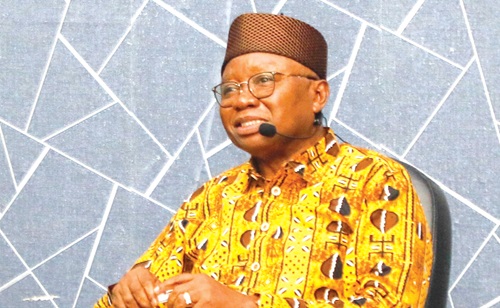
A former National Security Minister, Kofi Totobi Quakyi, has cautioned that failure to act courageously and forcefully on political vigilantism will set in place a cycle of reprisals and revenge that will undermine Ghana's democratic stability.
He said the country could not afford to continue on the path of revenge politics where successive governments overlooked acts of vigilantism perpetrated by their supporters.
Mr Quakyi gave the warning at a national policy dialogue on the topic: "Assessing the Implementation of the Vigilantism and Related Offences Act, 2019 (Act 999) and Its Implications for National Security and Democratic Governance."
The dialogue, organised by Election Watch Ghana, in Accra, brought together security experts, academia and political actors to assess the Act.
Vigilante groups
Mr Quakyi questioned whether the 36 vigilante groups identified prior to the passage of Act 999 had vanished or only changed their names and functions.
He said evidence on the ground pointed to a substantial increase in groups that fell within the scope of Act 999, with many of them still active but operating under new guises.
"A few days ago, there was a news report on the formation of a group called the Lions. Somebody who claimed to be the founder of the group said it would be operating within the context of Act 999, which allows groups that intend to help with community policing.
"I said to myself, this is the beginning of the problem," he said.
Mr Quakyi, who is also one-time Minister of Information, explained that a genuine community policing initiative could not be tied to a political party, since every community had members belonging to different political persuasions.
"When you know that the real intention of the people forming it is not about community policing, if it is coming from a particular political direction, you have to watch it very carefully," he stressed.
The former National Security Minister recalled a letter he wrote in which he warned that failure to deal decisively with vigilantism would sow seeds for future reprisals.
"As a country, we cannot continue the cycle of revenge and fighting.
That is why I think this forum is important for us to revisit Act 999, to assess to what extent we have dealt with the problem and if not, what are the factors impeding its implementation," he said.
Mr Quakyi also commended previous efforts outside the legal framework, including regular meetings with political parties, which helped to lower political tension, and urged the current administration to sustain such engagements to complement Act 999 or any new framework that may be introduced.
Violence signals system failure
A political scientist, Professor George Meyiri Bob-Milliar, said Ghana's success over the past three decades had been to delegitimise violence as an instrument of political competition, but warned that the persistence of violence signalled that something was not working in the democratic system.
"We talk of democratic consolidation. For us, what we are having now is the past that we live in.
"Ghana is described as a stable democracy, but when you look closely, these are the challenges.
We have to protect what we have built over these past three decades," Prof. Bob-Milliar said.
The professor of African Politics and History at the Kwame Nkrumah University of Science and Technology (KNUST), Kumasi, said Act 999 was a knee-jerk reaction to a major problem that had persisted through Ghana's electoral history, from 1951 through to the Fourth Republic.
"The Act itself is an outcome of party contestation. The underlying issues that created vigilante groups have not been addressed," he said, adding that the nature of party mobilisation in Ghana made the proliferation of such groups likely to continue.
Prof. Bob-Milliar said although awareness of Act 999 among political actors was now deep, reports indicated an increase rather than a decrease in vigilante activities.
"If you understand how party mobilisation is done in Ghana, what we can count on is that there will be more.
"The good thing is that all party actors now know the existence of this law, so if they are going to mobilise, they are mindful of what is likely to happen," he said.
He called on policymakers, academics and political parties to use the dialogue as an opportunity to make the law more effective and ensure that violence was not accepted as part of Ghana's democratic culture.