Ghana urged to ratify climate change agreement
The Republic of Korea has urged Ghana to expedite the ratification of the Korea-Ghana Framework Agreement on Climate Change Cooperation to pave the way for the implementation of joint climate projects, technology transfer and increased investment in the environmental sector.
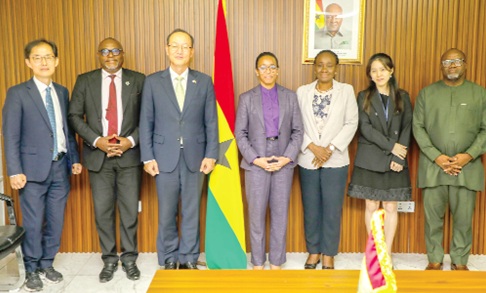
The Korean Ambassador to Ghana, Park Kyongsig, said this when he led a delegation from the Korea Environment Industry and Technology Institute (KEITI) Ghana Representative Office on a courtesy call on the Minister of Environment, Science and Technology, Dr Zenator Agyeman-Rawlings, in Accra.
The delegation included the First Secretary at the Embassy of the Republic of Korea, Jenie Son; the Chief Representative of KEITI Ghana, Dr Hong Seok Kim and the Head of Administration at KEITI Ghana, Emmanuel Bennin.
The agreement was signed in Seoul on March 11, 2026, during a meeting between President John Dramani Mahama and South Korean President, Lee Jae Myung.
Ambassador Park said ratification of the agreement by Parliament would allow the two countries to establish a joint committee to oversee cooperation, including the implementation of greenhouse gas reduction projects under Article 6.2 of the Paris Agreement.
Article 6.2 provides for voluntary cooperation between countries on greenhouse gas reduction activities, with resulting emission reductions potentially contributing to the countries’ Nationally Determined Contributions (NDCs).
Preparations
The ambassador said Korea had already begun laying the groundwork for the implementation of the agreement through KEITI, which established its Ghana Representative Office in Accra in April, 2024.
KEITI officially lists Ghana among its overseas offices, with its mandate including environmental industry support and inter-country cooperation programmes.
Mr Park said KEITI had been working with the ministry, including the Environmental Protection Authority (EPA), other government institutions, and some Korean partner companies to prepare greenhouse gas reduction projects.
He said the projects covered areas such as solid waste management, landfill gas-to-energy, safe drinking water and biogas.
The ambassador further proposed that Ghana co-host the Third Korea-Africa Environmental Cooperation Forum (KAECF) in 2027.
The proposed forum is expected to coincide with the 50th anniversary of diplomatic relations between Ghana and South Korea, and would bring together government representatives, development partners, private-sector players and other stakeholders from Ghana and other African countries.
It would focus on environmental policy and technology exchanges, climate-change projects, investment opportunities and partnerships between Korean companies and African countries.
The programme would also include an intergovernmental cooperation meeting, the signing of government-to-government and project-related agreements, as well as business-to-business meetings.
Collaboration
Dr Agyeman-Rawlings welcomed the proposal and said the ministry would work with relevant directorates and technical teams to examine the details and develop a solid foundation for the forum.
She said such a collaboration could help Ghana strengthen the link between academia, scientific research and industry, adding “we need private partnership and international support to unlock that”.
Dr Agyeman-Rawlings cited the Council for Scientific and Industrial Research (CSIR) as an institution with significant research capacity, but said more needed to be done to commercialise its research outputs.
On the Korea-Ghana climate change cooperation agreement, she said it was at the final stage of parliamentary consideration.
The minister expressed optimism that the collaboration would attract Korean companies to Ghana, while also creating opportunities for Ghanaian institutions and businesses to participate in projects across the environmental and climate sectors.