Ghana opposes attempts to abolish ICC
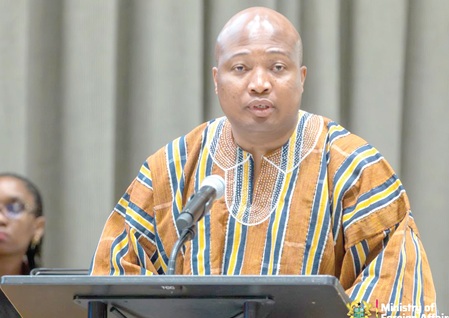
Ghana has opposed attempts to abolish the International Criminal Court (ICC), insisting the court must rather be strengthened to hold perpetrators of racism, genocide and crimes against humanity accountable.
The Minister of Foreign Affairs, Mr Samuel Okudzeto Ablakwa, said: "Ghana takes the firm view that there must be severe consequences for those who flagrantly violate the Durban Declaration and commit crimes against humanity.”
“We, therefore, are strongly opposed to attempts to abolish the International Criminal Court. The ICC should rather be strengthened to serve as our collective bulwark. The ICC needs our protection not our condemnation," Mr Ablakwa said.
He said the country remained fully committed to the principles of the Durban Declaration and its quest for reparatory justice, adding "together, we shall create a new world where all lives matter".
The minister made the country’s position clear at a High-Level Plenary Meeting to commemorate the 25th anniversary of the Durban Declaration and Programme of
Action at the UN in New York on Monday.
Commendation
Mr Ablakwa commended the UN for the special commemorative event, and recalled that some 25 years ago, the international community adopted a comprehensive framework to confront racism, racial discrimination, xenophobia and related intolerance.
"The Durban Declaration affirmed our shared responsibility to address historical injustices and dismantle the structures that perpetuate inequality. This solemn day must bring us to a reckoning that what our world needs is decisive action not more political declarations," he said.
"It should be of great consternation to us all that 25 years after the Durban Declaration, we still need to remind some people that all men and women are created equal; 25 years after Durban but we still have to proclaim that Black Lives Matter," the minister said.
Global failures
Mr Ablakwa cited ongoing global failures and said: "25 years after Durban, we seem to watch on helplessly as a genocide unfolds in Palestine with the two-state solution adopted by this Assembly becoming elusive each passing day.
25 years after Durban, but we cannot save the people of Sudan. 25 years after Durban, but xenophobic attacks have become a recurring feature in South Africa”.
The minister also said that it was indefensible that the UN itself had failed to uphold the Durban principles by ensuring Africa, a continent of 1.4 billion people was guaranteed a permanent seat on the Security Council.
"The Durban Commitments must become reality, not a mere slogan. President John Mahama spoke a timeless truth when he stated in this hallowed chamber a few days ago, that: 'No race is superior and no nation is inferior'," he said.
Reparatory
On reparatory justice, Mr Ablakwa said Durban's enduring significance lay in its recognition that historical injustices continued to shape present inequalities.
"Reparatory justice is, therefore, essential to restoring dignity, addressing inequalities and building long-lasting trust," he said.
He referenced paragraph 13 of the Durban Declaration, where the world said slavery should have been a crime against humanity.
"This year, we removed the 'should have been' by resoundingly correcting that historical injustice with the emphatic adoption of the Ghana-led landmark resolution declaring the trafficking of enslaved Africans as the gravest crime against humanity," the minister said.
“Now, we ask for what justice has always required.
An apology that is sincere; return of what was looted; repair for the harm that still lives on; and a promise, a real promise, that it will never happen again,” the minister said.