DTI, TVET sign MoU to strengthen skills training nationwide
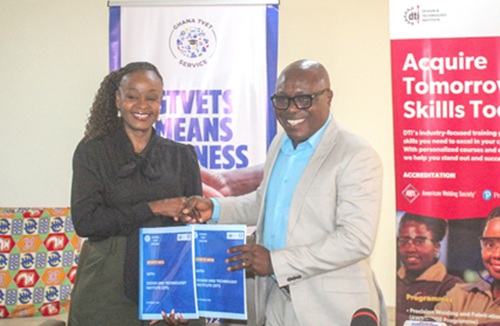
A memorandum of understanding (MoU) has been signed between the Design and Technology Institute (DTI) and the Ghana Technical and Vocational Education and Training (TVET) Service to strengthen Ghana's technical and vocational education and training system, enabling more young people to transition into dignified, job-ready work.
Rather than pursuing isolated projects, the agreement commits both parties to a systems approach that addresses institutional capacity, industry linkages, quality assurance and data integration across the sector.
Systems approach to TVET
Under the MoU, DTI and the Ghana TVET Service will diagnose institutional strengths and gaps and direct capacity building where it is most needed.
They will invest in trainer development and institutional leadership, embed industry through structured workplace learning and dual TVET/apprenticeship pathways, and improve the transition of learners into wage employment, self-employment, and enterprise, tracking outcomes transparently.
The partnership will also seek to advance digital systems for integrated skills data and pursue international benchmarks and recognise certification pathways to ensure Ghanaian skills are competitive globally.
Improve performance
The Founder of DTI, Constance Swaniker, acknowledged the system-wide challenges, including uneven training quality, trainer competency gaps, limited workplace exposure, weak school-industry linkages, fragmented data and underused equipment.
She noted that the MoU was "founded on a simple but powerful conviction that these challenges cannot be resolved through isolated interventions."
Ms Swaniker explained that the MoU seeks to improve performance across more than 235 TVET institutions, with a strong emphasis on documenting and scaling models within the public system to avoid isolated successes.
The collaboration clarifies complementary roles - the Ghana TVET Service contributes public-sector coordination, operational leadership, wide institutional reach and alignment with national priorities, while DTI brings technical expertise, systems design, institutional strengthening, trainer development, industry networks and implementation capacity.
Collaborative skills training
The Director-General of the Ghana TVET Service, Dr Eric Kofi Adzroe, stressed the urgent need for collaborative skills training to meet the rapidly evolving technological and economic realities.
He argued that partnerships among organisations were essential to design and implement practical, policy-aligned programmes that genuinely built capability rather than just confer credentials.
He mentioned upskilling teachers and facilitators so they could understand current industry practices and transmit relevant, advanced competencies, especially in design and technology.
"Certifications should enable people to do something better, not to secure them a job," he stated.
Dr Adzroe called for a broader, continental vision to ensure skill portability across African borders and added that standardising competencies and recognition would allow professionals to practice in multiple countries, reinforcing the idea that human mobility was inevitable but should be matched by transferable, recognised value.