Beyond the Catch: Women bear cost of fisheries crisis
Before the first canoe appears on the horizon, before fishermen begin pulling their nets ashore, women in Ghana’s fishing communities are already waiting at the beaches.
They sit patiently near the shore, their eyes fixed on the sea. For them, the return of a canoe carries more than fish.
It carries the hope of income, food for the family, school fees for children, money for health care and the ability to keep their small businesses alive.
However, when the canoe returns almost empty, the consequences extend far beyond the shoreline.
The women who smoke, process, trade and distribute fish are often the first to feel the impact of Ghana’s fisheries crisis.
While conversations around fisheries decline often focus on fishermen, illegal fishing and declining fish stocks, thousands of women who keep the post-harvest sector running are quietly carrying the burden.
They are the unseen workforce behind Ghana’s fishing economy.
According to the Food and Agriculture Organisation (FAO), women play a critical role in fisheries globally, particularly in processing, marketing and distribution.
In Ghana, women dominate the post-harvest fisheries sector, with their livelihoods closely linked to the availability of fish landed by artisanal fishermen.
The Fisheries Commission estimates that the fisheries sector supports the livelihoods of about 3.3 million people directly and indirectly, making any disruption in the sector a major social and economic concern.
For women along the coast, the crisis is not measured only by declining fish stocks.
It is measured by the number of days they could not work, the debts they accumulate, the businesses they struggle to maintain and the opportunities their children would lose.
A fishing closure that changed women’s lives
Ghana’s annual closed fishing season has become one of the country’s major interventions aimed at rebuilding depleted fish stocks.

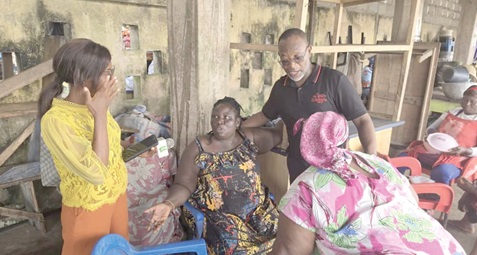
Maame Ekua Attaa (middle) and other women waiting for fishermen to arrive so they can purchase fish.
The policy, announced in 2018 and introduced in 2019, is designed to allow fish populations to recover by reducing fishing pressure during critical breeding periods.
However, for women whose livelihoods depend on daily fishing activities, the policy has also exposed the delicate balance between protecting the ocean and protecting communities.
A fish processor from Elmina, Maame Araba Nyaniba, said declining stocks affected not only their businesses but also social conditions within fishing communities.
For Felicia Abban, a fish processor from Cape Coast, when the canoe is empty, the kitchen is empty.
For women in fisheries, the biggest fear is not only losing business but losing their ability to provide for their families.
At Moree, fish processor Ekua Attaa explained that women’s livelihoods were directly connected to the success of fishermen.
“When fishermen do not get fish, we also have nothing to sell,” she said.
She explained that increasing fishing costs, particularly fuel challenges, continue to affect the entire value chain.
“When the fishermen complain about fuel prices, it affects us too.
The cost of fishing goes up, and the price of fish also increases. But customers are also struggling, so sometimes we cannot sell everything,” she added.
For women like Ekua, the fisheries crisis creates a difficult situation; they spend more money to buy fish but earn less profit because consumers cannot afford higher prices.
Keeping fisheries alive
At Elmina, Akua Vero rents pans used by fish processors and fishermen. She charges GH¢10 per pan daily.
“It may not be much, but it supports me. At least every day I get something small instead of sitting at home doing nothing,” she said.
For many women, however, the greatest danger facing their future is illegal fishing.
They believe destructive practices, including light fishing, are reducing fish availability and threatening the sustainability of the industry.
Illegal fishing
The Fisheries Commission and several environmental organisations have identified Illegal, Unreported and Unregulated (IUU) fishing as one of the biggest challenges facing Ghana’s marine fisheries.
Some non-governmental organisations (NGOs) in the fisheries and academics have revealed that IUU contributes significantly to economic losses and declining fish stocks.
For Elizabeth Cudjoe from Moree, illegal fishing is destroying the foundation of women’s businesses.
“The fishermen who know the proper traditional ways of fishing are becoming fewer.
Many people now depend on illegal methods, and it is affecting the future,” she said.
All the women interviewed called for stricter enforcement of fishery laws..
“If the sea is being overexploited, authorities must act.
The sea is not only for us today. It belongs to our children and future generations,” she added.
For decades, women have supported Ghana’s fisheries economy through their labour, investment and resilience.
There must be a renewed committment to protecting families, businesses and the future of communities that have depended on the ocean for generations.