Auditor-General calls for effective collaboration to ensure accountability
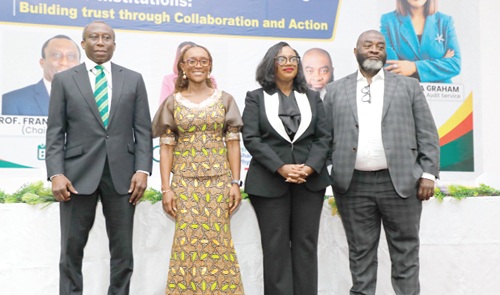
The Auditor-General, Dr Pamela Graham, has called for stronger collaboration among public institutions to ensure that audit findings lead to corrective actions, including recovery of public funds and improved accountability.
She said an audit report should not be the end of an accountability process, but the beginning of actions to address weaknesses identified and prevent their recurrence.
Graham made the call in Accra at the launch of the 2026 financial year audit of the Ghana Audit Service, on the theme: “Strengthening accountability oversight in public institutions: Building trust through collaboration and action.”
Dr Graham said accountability was a chain involving public institutions, the Audit Service, management, Parliament and enforcement institutions.
She said public institutions prepared and submitted financial information, the Audit Service audited and reported, management responded and took corrective action, while Parliament, principally through the Public Accounts Committee, exercised oversight.
The A-G said the Service audited more than 7,000 institutions annually.
These included about 5,000 ministries, departments and agencies; 261 metropolitan, municipal and district assemblies; more than 1,000 pre-tertiary and tertiary institutions; 116 subvented organisations and 79 public boards and corporations.
Dr Graham said 21 reports were generated from the Service’s work in the previous year and submitted to Parliament.
She also said that as of August 2026, the Service had recovered some GH¢17.6 billion, and helped in preventing wrongful payments amounting to about GH¢11.7 billion.
2026 guide
Dr Graham outlined five pillars: continuous engagement, timeliness, technology, people and impact to guide the 2026 audit cycle.
She said the Service would engage covered entities throughout the audit process and would expect them to submit complete records, and also respond to audit queries within agreed timelines.
Selected institutions would also undergo interim audits to identify problems early and reduce delays.
The A-G further announced plans to expand the use of data analytics, information systems auditing, forensic audit tools and appropriately governed artificial intelligence to identify anomalies and control weaknesses.
Meanwhile, the Service, she said, had developed an Audit Recommendations Tracker which would be rolled out next month to monitor the implementation of recommendations.
The tracker would show which recommendations had been implemented, outstanding recoverable amounts, corrective measures taken and systemic weaknesses that continued to expose public resources to risk.
Dr Graham said where expenditure was found to have been incurred contrary to the law, she would exercise the constitutional powers of disallowance and surcharge.
“The resources we audit belong to the people of Ghana.
Every cedi lost through weak controls, unlawful expenditure, inefficiency, or failure to act is a cedi withheld from education, health care, infrastructure and social protection,” she said.
Oversight
The Chairperson of the Public Accounts Committee, Abena Osei-Asare, said accountability should begin before the Auditor-General arrived at an institution.
She said transactions must be authorised, contracts documented, procurement rules followed, assets recorded and accounts reconciled.
Mrs Osei-Asare said recent reports continued to show recurring weaknesses in record keeping, reconciliation, revenue collection, procurement and unsupported payments.
Professor Francis Dodoo, Presidential Advisor for the National Anti-Corruption, urged staff to ensure that persons who misappropriated public funds faced appropriate sanctions, including recoveries.
A legal practitioner and corporate executive, Dr David Ofosu-Dorte, called for the modernisation of auditing methods and greater public education on the work of the Audit Service.