$66.9m approved to fight corruption over 5 years
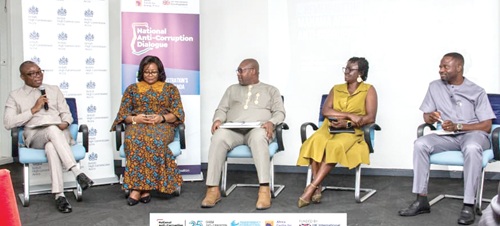
The government has approved $66.9 million for the next five years to support the implementation of the National Anti-Corruption Action Plan (NACAP), the Research and Policy Coordinator for NACAP at the Office of the President, Jonathan Gador, has disclosed.
He said Cabinet’s approval demonstrated the government’s commitment to making the fight against corruption sustainable, while efforts were underway to introduce legislation to ring-fence funding for anti-corruption institutions.
Mr Gador said it was important to equip anti-corruption institutions with efficient laws, adequate resources and the tools required to effectively discharge their mandates.
He was speaking at a panel discussion during the National Anti-Corruption Dialogue 2026 in Accra on Thursday, September 10.
It was on the theme: “From Commitment to Delivery: Reviewing the Mahama Administration’s Anti-Corruption Agenda After 18 Months.”
The dialogue, organised by the Ghana Anti-Corruption Coalition in partnership with the Africa Centre for Energy Policy and Ghana Integrity Initiative (GII), brought together government officials, anti-corruption institutions, CSOs, academia, the private sector, media, youth and women’s groups to assess progress and challenges in Ghana’s anti-corruption drive.
Sustainable funding
The Presidential staffer on Research and Policy Coordinator for NACAP said NACAP had identified sustainable financing for anti-corruption institutions as critical to the fight against corruption.
He said the government had engaged the Constitutional and Legal Committee of Parliament on developing a framework to guarantee sustainable funding.
He added that President John Dramani Mahama had indicated his commitment to identifying a mechanism to achieve that objective, expressing the hope that the necessary legislation would be in place before the end of his tenure.
Mr Gador also called for stronger collaboration among anti-corruption institutions, saying protocols would be developed to facilitate the sharing of assets, technical expertise and other resources.
“There is no reason why one institution would have a forensic lab and another one would be looking for another forensic lab,” he said.
CSOs applauded
On behalf of civil society organisations (CSOs), the Executive Director of the Ghana Integrity Initiative (GII), Mary Addah, commended the Mahama administration for what she described as significant progress in implementing its anti-corruption commitments.
She said the government was “on track” in translating its manifesto promises into concrete actions and praised its engagement with civil society in developing anti-corruption policies.
Mrs Addah, however, expressed concern over difficulties in obtaining information from some public institutions, including unanswered requests to the Attorney-General’s Office.
She also criticised Parliament for limited engagement with CSOs on important anti-corruption legislation, including the Conduct of Public Officers Bill.
Mrs Addah further urged the government to address perceptions of selective accountability, stressing that equal treatment under the law was crucial to the credibility of the anti-corruption agenda.
Mahama serious
Investigative journalist, Manasseh Azuri, also said the Mahama administration had demonstrated greater seriousness in fighting corruption, although some of its actions required closer scrutiny.
He cited the establishment of the Value-for-Money Office, Operation Recover All Loot (ORAL), the reduction in the number of ministers and the cancellation of the Strategic Mobilisation Ghana Limited (SML) contract as notable achievements.
Mr Azuri said the Value-for-Money Office must prove that it could deliver where existing procurement institutions had failed.
He said information from the Attorney-General’s Office indicated that eight ORAL cases were active in court, 17 dockets were ready and under review, while 15 investigations were ongoing.
He also cited figures from the Economic and Organised Crime Office (EOCO), which he said recovered GH¢640 million in 2025, describing it as the agency’s largest single-year recovery.