Women waste collectors deserve better — Makafui Awuku
Call him the ‘viral plastic man’—and you’d be right. From his first Christmas tree made with discarded plastic bottles, to fashion accessories woven from sachet water bags, and now durable school desks built from the same waste, his journey is proof that no plastic has to go to waste.
From Accra to the world, Makafui Awuku and his team keep catching the spotlight with their bold plastic transformations.

At his centre, tucked away from the bustle of the city, no plastic waste goes to waste. Even the fine “plastic dust” from shredded sachet water bags is reborn—blended with cement and shaped into flower pots that add beauty to the surroundings.
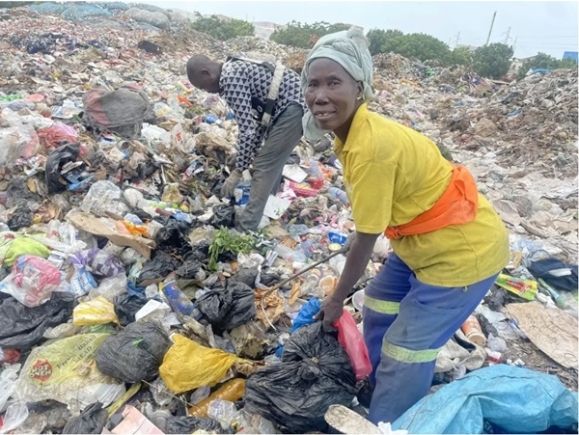
When The Mirror team toured his facility, at Mckingtorch Africa, last Tuesday, Mr Awuku spoke of his desire to expand their work and impact, and highlighted how underpaid plastic waste collectors—especially women—are.
“Sixty per cent of waste collectors are women who are at the bottom of the value chain. They are paid the least and work under terrible conditions. We need to fix this situation because if they withdraw their services, our sanitation situation will get worse.
We need to create decent jobs for these women. Our model is to create decent jobs and be able to transition them from just collecting the waste, buying back their waste at good values and also create jobs for the artisans who work on the pieces we produce,” he said.
“A lot of people in Ghana now depend on sachet water, which is the cheapest source of clean and safe water. The dependency on sachet water continues to increase as more of our water bodies get contaminated. But with his comes a lot of pollution from the way the sachets are disposed of. These women move around collecting sachets without gloves or PPE, which poses hazards to their health,” he added.
Finding solutions
Before 2017, when his first plastic Christmas tree went viral, Mr Awuku, who is asthmatic, thought of ways to reduce the burning of plastics and other substances, which triggered and worsened his condition.
He resolved to find ways to make what was considered waste useful.
“If I didn’t find a solution, they were going to kill me with their activities,” he said.
Being selected as a Fellow under President Obama’s Young African Leaders Initiative (YALI) exposed him to the Sustainable Development Goals (SDGs). After his training, he was more informed about what he could do with plastic waste to help the environment.
That first installation sparked a journey of learning and research, which has since produced countless useful pieces from plastic waste—materials that would otherwise have been left to damage the environment.

Today, their biggest innovation, making desks and roofing sheets from sachet water bags, draws attention—so much that even global media can’t look away.
Long before the viral desks and roofing sheets, Mr Awuku and his team had captured public attention with innovations ranging from shredded recycled-plastic throw pillows and reusable bags to plastic recovery receptacles, car-tire handwashing stations, sleeping mats, and footwear fashioned from sachet water bags.
Circular economy
He explained that whenever they set out to design a new product, they began by asking what kind of waste it could produce—and how that waste could be turned into something useful instead of polluting the environment.

“For instance, in producing the boards for our desks, the trimming creates a fine waste similar to sawdust—only this time, it’s plastic dust. We repurpose it for flower pots. If left in the environment, these microplastics make their way to the sea, are consumed by fish, and eventually by humans.

“Normally, used car tyres are burned, causing pollution. But when we paint and repurpose them as handwashing stations, they become useful while also reducing environmental harm. Through our plastic recovery receptacles, the bottles we collect are turned into new products, and the surplus is sold to other recyclers. The circular model is about maximising resources and minimising waste—and that’s always central to our product development,” he explained.
Building sustainable communities
Mckingtorch Africa, he added, was focused on building sustainable communities and cities in Africa through circular economy innovations.
Their services include plastic waste segregation innovation, environmental sustainability advocacy, recycled waste public space installations, waste recovery services, institutional and academic research partnerships on circular economy, environmental sustainability consultancy, advocacy, and environment and climate startup incubations.
With adequate funding, Mr Awuku hopes to employ more young people and women and increase their capacity to meet their increasing demand.

At his hub at Adenta, he is currently constructing a space where small groups can have access to books on sustainability or hold conversations around the environment and its sustainability. To make it more relatable, the shed is currently roofed with the sheets made from recycled water sachet bags.

Mr Awuku and his team are turning plastic into magic. To build a single desk, they need roughly 12,000 packs of sachet water (collected in bags of 30). That means every sachet counts. Rather than burning them or mixing them with general waste, set them aside and donate them —whether to the women who collect waste or directly to the hub—and receive a small thank-you gift in return.
efiaamoakoa2@gmail.com