Ministry, partners review Domestic Violence policy
Following the expiry of its implementation period, the National Domestic Violence (DV) Policy (2009 - 2019) and its Plan of Action for the Implementation of the Domestic Violence Act (732) of 2007 is set to undergo a review.
The review, being spearheaded by the Ministry of Gender, Children and Social Protection, is expected to fine tune the existing law to reflect and respond better to modern challenges related to domestic violence prevention and management and also track implementation successes and challenges to inform the development of a robust new policy.
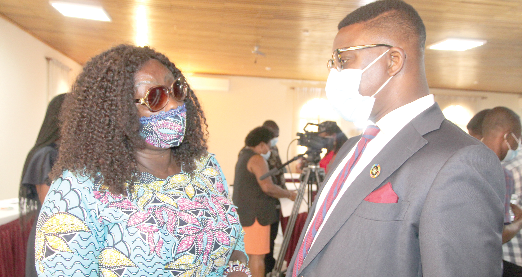
As part of the review process, the Domestic Violence Secretariat of the Ministry, with financial and technical support from the United Nations Population Fund (UNFPA), engaged key stakeholders at a day’s consultative workshop in Accra yesterday to solicit their recommendations into the new policy.
The stakeholders included representatives of development partners, policy makers, the Judiciary, Civil Society Organisations, Faith-based Organisations, and the media.
Policy and Act
The DV Act (732) of 2007 was passed by Parliament in June, 2007 to provide protection from domestic violence, particularly for women and children who were obviously more affected.
The overall goal of the 10-year policy document was to facilitate the elimination of domestic violence from the Ghanaian Society, and create family cohesion and provide a peaceful environment to accelerate national development.
Speaking at the meeting, the Deputy Minister of Gender, Children and Social Protection, Ms. Freda Prempeh, said the review had become necessary because its implementation period was set at 2009 to 2019 and, therefore, a new policy was required.
He reminded stakeholders to be mindful of the overall goal of the policy in the review process, which, she said, was to eliminate domestic violence and provide adequate response if it happened.
She acknowledged that despite efforts made by the state and international community, domestic violence still remained a barrier to gender equality in most countries including Ghana.
“Domestic violence denied survivors of their fundamental human rights and weakens human development goals. Apart from the adverse consequences on battered females and children in relation to their health, psychological and emotional well-being, domestic violence undermined and compromised on their wellbeing’’, she said.
She commended the UNFPA for its immense financial and logistical support and the Domestic Violence Coalition, whose efforts facilitated the birth of the policy in 2007.
UNFPA on DV
The Country Representative of the UNFPA, Mr. Niyi Ojuolape, said the United Nation’s agency, like all partners, was concerned about the rising incidence of domestic violence as one of the most prevalent human rights violations in the world.
He said the UNFPA recognised that despite the existence of several legal frameworks and institutions, a large segment of the population, especially women, girls, and children, continued to suffer violence in all its forms.
He said domestic violence, in the form of physical, economic, psychological, and sexual abuse, disproportionately affected women and girls.
The UNFPA country representative said a survey conducted in 2016 indicated that 27.7 per cent of Ghanaian women had experienced at least one form of domestic violence in 12 months prior to the survey while young women between 15 and 19 were up to four times more likely to have experienced domestic violence than women between 30 and 39.
“Therefore, we believe that there is the need for us to improve on prevention efforts as well as effective management of cases to mitigate the long-term effects on victims. The recent lynching of an elderly woman due to mere allegations is an incident that requires immediate attention in order to prevent such crimes from reoccurring”, he said.
Further commenting on domestic violence, he said “It knows no social, economic or national boundaries and undermines the health, dignity, security, and autonomy of its victims.’’
He commended the ministry for bringing together stakeholders of diverse prowess to deliberate and recommend inputs into the new policy and praised the government for its efforts to eliminate domestic violence.
Mr. Ojuolape charged the participants to take into consideration the ever-evolving digital world and reflect the needs and realities of women and girls, person with disabilities, and hard to reach communities, among other vulnerable groups.
Writer’s email: doreen.andoh@graphic.com.gh