GH¢225bn in, GH¢234bn out - Taxes funded 86% of revenue as wages, transfers and debt interest absorbed 80% of spending
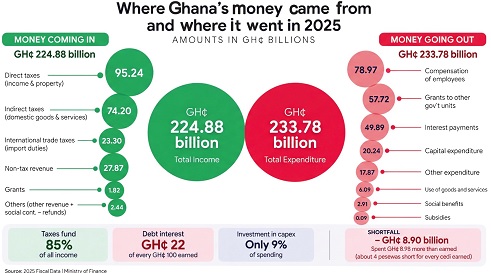
Ghana’s 2025 public finances reveal an economy still operating under tight fiscal constraints, with tax revenue carrying most of the burden of financing the government while wages, transfers and debt-interest payments absorb the bulk of expenditure.
The government collected GH¢224.88 billion in revenue and grants last year.
However, it spent GH¢233.78 billion, highlighting the pressure on its finances as taxes remain the main source of money while wages, transfers and debt servicing take up much of the budget.
The figures from the Ministry of Finance show that the government spent about GH¢8.90 billion more than the revenue and grants it received during the year.
The gap, however, should not be taken as the official budget deficit.
The ministry reported an overall fiscal deficit of 1.0 per cent of Gross Domestic Product (GDP) and a primary surplus of 2.5 per cent of GDP for 2025.
But the numbers offer an important picture of where the country’s money came from and where it went.
They show a government that still depends heavily on taxes to raise money, while a large part of its expenditure goes to salaries, transfers and the cost of servicing debt.
Taxes remain main source of money
Taxes provided the biggest share of the government’s revenue in 2025.
Direct taxes, indirect taxes and taxes on international trade together brought in about GH¢192.74 billion, representing roughly 86 per cent of total revenue and grants.
Direct taxes brought in GH¢95.24 billion, making them the largest of the three.
Indirect taxes followed with GH¢74.20 billion, while taxes on international trade contributed GH¢23.30 billion.
The figures show just how much the government depends on the economy to raise money.
When businesses make more sales, workers earn more and economic activity increases, the government generally collects more taxes.
But when businesses struggle or economic activity slows, tax collections can also come under pressure.
The founder and lead trainer of Finex Skills Hub, Bernard Obeng Boateng, said the heavy reliance on taxes meant the government’s ability to finance its programmes remained closely linked to economic activity and how effectively taxes were collected.
The ministry’s year-end figures show that non-oil tax revenue was GH¢179.16 billion, while non-tax revenue amounted to GH¢27.87 billion.
Grants were much smaller at GH¢1.82 billion.
This means that, for now, taxes will continue to be the main engine of government revenue.
Where the money went
On the expenditure side, compensation of employees was the biggest item, at GH¢78.97 billion.
This was followed by grants to other government units, at GH¢57.72 billion, and interest payments of GH¢49.89 billion.
Together, these three items accounted for about GH¢186.58 billion, or roughly 80 per cent of total government expenditure.
In simple terms, about GH¢80 out of every GH¢100 spent by the government was on salaries and other employee costs, transfers to government institutions and the cost of servicing debt.
That leaves a much smaller amount for other government programmes, including roads, schools, hospitals, water, energy and other development projects.
The spending pattern is, therefore, one of the biggest challenges facing the country’s finances.
Much of the government’s money is already committed even before it can decide how much to put into new projects.
Debt still takes big bite
The GH¢49.89 billion spent on interest payments shows that Ghana’s debt continues to place a heavy burden on the budget.
The interest bill was equal to about 22 per cent of total revenue and grants.
Put simply, for every GH¢100 the government raised, about GH¢22 was to paying interest on debts.
This does not mean that the GH¢22 was used to reduce the amount the Ghana owes.
Interest is the cost of borrowing money and is paid in addition to the repayment of the debt itself.
The figure helps explain why the country’s debt problems have had such a big impact on the budget.
Ghana’s debt restructuring and efforts to control new borrowing are, therefore, important not only for reducing debt but also for freeing money for other government priorities.
Small share goes into development
Another important feature of the 2025 figures is the relatively small amount spent on capital projects.
Capital expenditure was about GH¢20.24 billion, representing roughly nine per cent of total expenditure.
That means that for every GH¢100 the government spent, only about GH¢9 went into capital projects.
Capital expenditure covers projects and assets such as roads, hospitals, schools, power infrastructure and other investments that can support the economy over many years.
The small share going into such projects shows the difficult choices facing the government.
Ghana needs to build infrastructure and improve public services, but much of its money is already being used to pay workers, transfer funds to other government institutions and service debt.
Surplus before debt interest
The 2.5 per cent primary surplus reported by the Ministry of Finance provides an important part of the story.
A primary surplus means the government collected more money than it spent on its main activities before interest payments on debt are taken into account.
This suggests that the government’s efforts to control its expenditure and improve its finances are beginning to bear fruits.
But once interest payments are included, the country would have recorded an overall deficit of 1.0 per cent of GDP.
The key issue for Ghana is, therefore, not only how much money the government raises or spends but how much is left after settling existing commitments.