From stability to the kitchen:
Are Ghana’s Falling Reserves and Rising Debt Becoming a New Economic Scare, and Can Macroeconomic Stability Be Turned into Jobs, Affordable Credit and Household Prosperity?
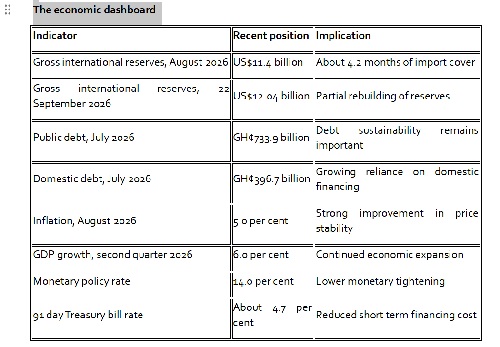
Ghana’s economic story is entering a new and more demanding phase. Today, several headline indicators suggest that important progress has been made. Inflation has fallen sharply, economic growth remains relatively strong, Treasury bill rates have declined considerably and international reserves have recovered significantly from the most difficult period of the recent economic crisis.
Yet, across homes, markets, shops, factories and offices, one question is becoming increasingly difficult to ignore: When will macroeconomic stability begin to translate into improved living conditions for ordinary Ghanaians?
Fresh BoG data subsequently showed reserves recovering to about $12.04 billion by September 22, 2026.
At the same time, Ghana’s public debt increased from GH¢720.8 billion in May to GH¢733.9 billion in July, 2026. Domestic debt rose more significantly from GH¢379.1 billion to GH¢396.7 billion over the same period.
These movements highlight an important truth. Ghana may have moved beyond the most difficult phase of macroeconomic instability, but the country is now confronting the equally difficult task of converting stability into productivity, investment, employment and improved household welfare.
Why reserves matter
International reserves are among the most important buffers protecting an economy from external shocks.
Ghana requires foreign exchange to import petroleum products, medicines, machinery, industrial inputs, vehicles, technology and some food products. Adequate reserves strengthen confidence in the cedi and improve the ability of the Bank of Ghana to manage excessive volatility in the foreign exchange market.
The decline from approximately US$12.94 billion in June to about US$11.4 billion in August therefore deserves attention.
The deeper question is whether Ghana’s foreign exchange earnings are sufficiently diversified and sustainable.
Gold has become an increasingly important source of foreign exchange. Yet, overdependence on gold, cocoa and crude oil exposes the country to commodity price swings, production disruptions and changing global conditions.
Ghana, therefore, needs a broader export economy built around agro processing, pharmaceuticals, manufacturing, tourism, technology services, financial services and value-added mineral processing.
Rising debt must be watched carefully
Ghana’s public debt reached GH¢733.9 billion in July 2026, up from GH¢720.8 billion in May.
The critical issue is whether borrowing generates sufficient economic returns.
The increase in domestic debt is particularly important. Domestic debt rose by GH¢17.6 billion between May and July.
Greater domestic borrowing may reduce foreign currency exposure, but it can also create pressure within the local financial market. The Government may compete with businesses for available funds, making it more difficult for companies to secure affordable credit.
This can produce a crowding out effect, where banks and investors prefer relatively safe government securities to financing private businesses.
Ghana must, therefore, ensure that domestic borrowing does not weaken the very private sector that is expected to create jobs and drive growth.
The business test
For businesses, economic recovery must be practical.
Lower inflation should help stabilise input costs. Lower Treasury bill yields should create conditions for cheaper lending. Relative currency stability should make planning and pricing easier.
They need affordable credit, reliable electricity, predictable taxation, stable regulation, efficient transport systems and customers with purchasing power.
If government can borrow at significantly reduced rates while viable businesses continue facing expensive credit, then macroeconomic stabilisation will remain incomplete.
Agriculture, manufacturing, technology, construction and small and medium enterprises must increasingly benefit from the improved monetary environment.
The kitchen test
For households, however, the most important test is much simpler.
Can families afford food, transport, rent, electricity, healthcare and education?
This explains why macroeconomic improvement may not immediately produce household relief.
The decisive question is, therefore, whether incomes are growing faster than the cost of essential goods and services.
Ghanaians will ultimately judge the recovery by whether workers can save more, businesses can employ more people, young graduates can find jobs and families can meet their basic obligations without excessive financial stress.
Conclusion
Ghana has made important macroeconomic gains.
Inflation has fallen, economic growth remains resilient, government financing costs have declined and reserves remain considerably stronger than during the height of the recent economic crisis.
But these gains should not lead to complacency.
The recent pressure on international reserves and rising domestic debt demonstrate that the recovery still requires careful management.
The next challenge is no longer merely stabilisation.
It is transmission.
Lower inflation must translate into stronger purchasing power. Lower interest rates must translate into affordable business financing. Economic growth must create sustainable employment. Strong reserves must deliver currency confidence.
And ultimately, macroeconomic progress must mean that ordinary Ghanaians have more money left after paying for food, transport, education, healthcare, rent and utilities.
Only then will Ghana’s recovery move beyond economic reports and official statistics.
Only then will it reach the market, the workplace, the pocket, and most importantly, the Ghanaian kitchen.