Nigerian banks outshine rivals - Only 6 industry lenders meet BoG’s NPL quality test
A growing divide has emerged in the country’s banking industry, with Nigerian-owned lenders posting the country's healthiest loan books, while most locally owned banks continue to grapple with crippling levels of bad debt.
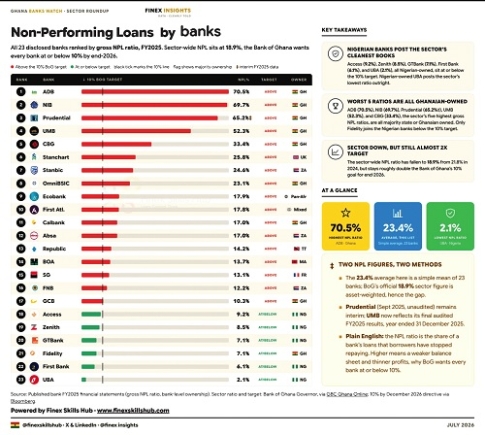
Fresh industry data show that six of the strongest performers on asset quality are either Nigerian-owned or part of Nigerian banking groups, while the five banks with the highest Non-Performing Loan (NPL) ratios are all Ghanaian-owned, highlighting stark differences in credit risk management and lending practices.
The divergence comes even as the banking sector's overall NPL ratio declined to 18.4 per cent in February from 22.6 per cent a year earlier, reflecting stronger loan recoveries and write-offs.
Yet, the industry's asset quality remains well above the Bank of Ghana's prudential target of 10 per cent, with only five of the 23 disclosed banks meeting the regulatory benchmark.
Domestic banks under pressure
The latest rankings paint a worrying picture for several indigenous lenders.
The Agricultural Development Bank (ADB) recorded the highest NPL ratio at 70.5 per cent, meaning more than seven out of every 10 cedis it has lent are classified as non-performing.
The National Investment Bank followed with 69.7 per cent, ahead of the Prudential Bank (65.2 per cent), the UMB Bank (52.3 per cent) and the Consolidated Bank Ghana (33.4 per cent).
Such elevated ratios suggest deep-seated credit quality challenges that continue to weigh on profitability, weaken capital buffers and restrict banks' capacity to extend new credit to businesses and households.
Nigerian associated banks
By contrast, the UBA Ghana posted the industry's lowest NPL ratio at just 2.1 per cent.
It was followed by the First Bank Ghana (6.1 per cent), the Fidelity Bank and the GTBank Ghana (both 7.1 per cent), the Zenith Bank Ghana (8.5 per cent) and the Access Bank Ghana (9.2 per cent).
All six institutions comfortably remain below the Bank of Ghana's prudential threshold, underscoring stronger underwriting standards, tighter risk controls and healthier loan portfolios.
Ownership pattern emerges
Beyond the rankings, the data reveal a clear ownership pattern.
Most of the banks with the lowest bad loan ratios are subsidiaries of Nigerian banking groups, while those with the weakest asset quality are predominantly Ghanaian-owned institutions.
The Founder and Lead Trainer of Finex Skills Hub, Bernard Obeng Boateng, said the trend warrants closer scrutiny.
"Although ownership alone does not determine asset quality, the pattern points to differences in credit risk management, portfolio composition and lending practices that deserve closer analysis," he said.
He noted that many domestic banks have historically maintained larger exposures to indigenous businesses and sectors that were hardest hit during the country’s recent economic crisis.
In contrast, several foreign-owned lenders have generally adopted more conservative lending strategies, stronger credit underwriting and more rigorous risk management frameworks.
Why bad loans matter
Asset quality remains one of the clearest indicators of the health of a banking system.
A loan is classified as non-performing when a borrower fails to make scheduled principal or interest payments for at least 90 days.
High NPL ratios erode interest income, force banks to make larger loan-loss provisions, weaken profitability and place pressure on regulatory capital.
They also reduce banks' ability to extend fresh credit, limiting investment and slowing broader economic activity.
Although the country’s banking industry has made measurable progress in reducing impaired loans, the pace remains insufficient to achieve the central bank’s ambition of lowering the sector-wide NPL ratio to 10 per cent by the end of 2026.
Different measures, different picture
The Bank of Ghana's official sector NPL ratio is calculated using an asset-weighted methodology that reflects the relative size of each bank's loan portfolio.
By contrast, a simple arithmetic average across the 23 disclosed banks assigns equal weight to each institution, regardless of size, yielding a higher industry average.
While both approaches are statistically valid, they offer different perspectives on the overall health of the banking sector.
Long road to recovery
The decline in bad loans suggests that the country's banking sector is gradually recovering from one of its most challenging periods in decades.
Improved macroeconomic conditions, stronger loan recoveries and balance-sheet clean-ups are beginning to ease pressure on lenders.
However, the recovery remains uneven. With nearly four out of every five disclosed banks still above the central bank's asset quality benchmark, significant work remains.
For many lenders, restoring healthy balance sheets will require more than loan recoveries.
Sustained improvements in credit underwriting, loan monitoring, portfolio diversification and risk management will be essential if the industry is to rebuild resilience, support stronger lending and meet the Bank of Ghana's end-2026 target.