GCB leads deposit race with GHc41.05b - With Ecobank, Stanbic, Zenith, Absa in big league
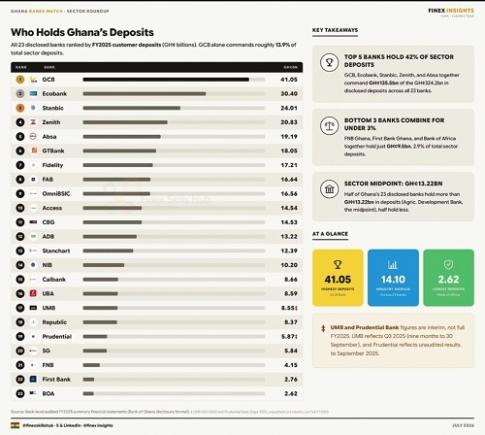
GCB Bank has firmly reasserted its status as the biggest bank in the financial sector, capturing a commanding GH¢41.05 billion in customer deposits to lead the country’s commercial banking rankings for the 2025 financial year.
According to new data compiled by the finance research organisation, Finex Skills Hub, GCB’s massive haul represents roughly 13.9 per cent of the total GH¢324.2 billion held across the country’s 23 disclosed commercial banks.
Behind GCB Bank, the battle for the remaining podium spots remains fiercely contested but dominated by the familiar corporate giants. Ecobank Ghana secured second place, reporting GH¢30.40 billion in customer deposits, closely followed by Stanbic Bank in third place with GH¢24.01 billion.
Zenith Bank and Absa Bank completed the top-five elite bracket, with both institutions comfortably crossing the crucial GH¢19 billion threshold.
Together, these five institutions form an oligopoly at the apex of Ghanaian banking, highlighting a sector where scale has increasingly become an existential requirement.
Power of state sovereign brand
GCB Bank’s comfortable lead at the top of the deposit table is not a historical accident.
In an era where nimble, digital-first fintech platforms and younger private banks are aggressively courting retail consumers with slick interfaces, GCB’s fortress remains anchored in unparalleled physical reach, long-standing institutional memory, and deep state patronage.
Lead Trainer and Founder of Finex Skills Hub, Bernard Obeng Boateng, says, "GCB’s lead in the deposit category did not happen by accident".
"It reflects decades as one of Ghana's oldest banks, a branch network that reaches deeper into the country than almost any competitor, and long-standing relationships with government and public-sector institutions that newer entrants simply haven't had the time to build."
This institutional inertia provides a powerful, low-cost funding hedge, particularly during periods of macroeconomic volatility when depositors prioritise capital preservation over high yields.
Finance lecturer at the Kwame Nkrumah University of Science and Technology (KNUST) School of Business, Dr Abukari Salifu Atchulo, argues that GCB’s conservative, risk-averse profile has effectively turned it into a safe haven.
"GCB has become more attractive because of the government support, which for many, provides depositors with reassurance and security," Dr Atchulo notes.
"Again, it is invariably the only bank with 'Ghana' attached to its name.
This gives the bank an implicit credibility. Because the bank maintains a massive network of physical branches, its deposit mobilisation becomes significantly easier and cheaper than its rivals."
Tier-one banks
The five largest banks collectively hold GH¢135.5 billion, accounting for approximately 42 per cent of all disclosed customer deposits in the country.
In commercial banking, customer deposits serve as the fundamental bedrock of institutional health—they are the primary engine driving lending capacity, liquidity buffers and long-term financial stability.
Tier-1 players like GCB, Ecobank and Stanbic benefit from an enviable virtuous cycle: their massive deposit bases provide them with cheap, stable funding.
This, in turn, gives them the flexibility to underwrite large corporate credits, invest heavily in cutting-edge digital infrastructure, and absorb economic shocks far better than their less-capitalised peers.
Such asymmetry is common in developing banking markets. Larger institutions naturally benefit from extensive legacy networks, stronger corporate relationships, and an established layer of customer trust that takes decades to cultivate.
Competitive middle tier
Yet, beneath the tier-one giants sits a highly volatile and crowded middle market.
A robust cluster of mid-tier institutions—including GTBank, Fidelity Bank, First Atlantic Bank, OmniBSIC, Access Bank Ghana, Consolidated Bank Ghana (CBG), and the Agricultural Development Bank (ADB)—each hold between GH¢13 billion and GH¢18 billion in customer deposits.
The Agricultural Development Bank serves as the exact market median for the sector, reporting GH¢13.22 billion in deposits.
This means exactly half of the country’s 23 banks sit above this benchmark, while the other half fall below it.
The relatively tight grouping within this middle tier indicates a fiercely competitive battleground.
For these banks, minor shifts in corporate mandates, a breakout digital banking product, or an aggressive retail campaign could easily alter the rankings, offering genuine opportunities for upward mobility through agile execution and superior customer service.
Scale and road ahead
Conversely, the bottom of the table underscores the harsh realities facing smaller foreign subsidiaries and niche operators in an increasingly expensive operating environment.
At the lowest end of the ranking, FNB Ghana, First Bank Ghana and the Bank of Africa together hold just GH¢9.5 billion—a meager 2.9 per cent of the total sector deposits.
While these smaller institutions often carve out highly profitable, specialised niches in fields like structured trade finance, cross-border corporate transactions, or high-net-worth wealth management, the numbers illustrate the brutal scale advantage enjoyed by GCB and its immediate peers.
As Ghana’s banking sector continues to mature under strict regulatory oversight, deposit size alone will not guarantee absolute success; profitability, asset quality and cost-to-income ratios remain the ultimate arbiters of corporate health.