African fraud stakeholders dialogue
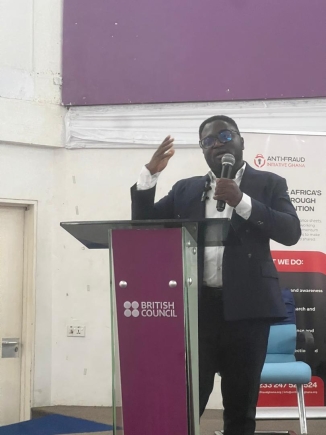
A landmark forum on fraud prevention has ended in Accra with a strong call for collaboration among state institutions, financial organisations, law enforcement agencies and the private sector to combat the growing threat of digital fraud in Ghana and across Africa.
The maiden African Fraud Stakeholders Dialogue, organised by the Anti-Fraud Initiative Ghana, was held at the British Council in Accra on Tuesday with the theme: "Mobilising collective action against fraud."
It brought together parliamentarians, government institutions, law enforcement agencies, financial institutions, religious and civil society organisations, academia and technology companies.
Delivering a speech on behalf of the Minority Leader, Alexander Afenyo-Markin, the Member of Parliament for Suame, John Darko, said the fight against fraud was a collective responsibility requiring strong legislation, rigorous oversight and effective enforcement.
He said Parliament occupied a central position in the national effort, noting that Article 93 of the 1992 Constitution establishes Parliament as the legislative authority of the state, while Article 103 provides for parliamentary committees to examine matters within their respective mandates.
"Parliament must ensure that our legal framework keeps pace with technological developments. Laws designed for an earlier era must be reviewed when necessary to address emerging forms of cybercrime," he said.
Growing threat
In a presentation, the acting Deputy Director-General of the Cyber Security Authority, Stephen Cudjoe-Seshie, painted a worrying picture of the fraud landscape in Ghana.
He disclosed that Ghana's population stands at about 35.2 million, with 36.3 million internet users. Mobile money accounts have reached 85.8 million, with transactions totalling about $8 billion this year alone.
Citing statistics from the Cyber Security Authority, he said 2,031 incidents were reported in 2024, with online fraud accounting for a significant proportion. Losses recorded exceeded GH¢15 million.
"This year, we are looking at nearly the same number of incidents as the entire last year, meaning we are getting more reports. The losses have more than doubled," he said.
He identified online shopping fraud, job scams, impersonation of brands and deepfakes powered by artificial intelligence as emerging threats. He also disclosed that two fintech companies had suffered attacks, with about GH¢35 million stolen from their systems.
EOCO's successes
The Head of Intelligence at the Economic and Organised Crime Office (EOCO), Patrick Yankey, who spoke on "Destruction of Organised Fraud Networks: Strengthening Financial Intelligence and Inter-Agency Collaboration Against Digital and Cross-Border Financial Crime," said no single institution could effectively tackle fraud alone.
He said EOCO, established under Act 804, had a broad mandate covering money laundering, cyber fraud, tax fraud, human trafficking, organised crime and terrorist financing.
Mr Yankey cited several successes recorded through collaboration with local and international partners, including the seizure and confiscation of 65 vehicles in a joint operation with the FBI and Canadian authorities.
QNET speaks
The Head of Global Compliance at QNET, Naana Quartey, also addressed the forum, clarifying the company's business model and warning against the misuse of its brand by criminal networks.
She disclosed that law enforcement agencies, including Interpol and the United Nations Office on Drugs and Crime (UNODC), have adopted the term "Model Q" to describe the criminal phenomenon in which fraudsters use the QNET name to perpetrate fake employment offers, deceptive recruitment and illegal travel arrangements.
"Anyone who uses the QNET brand as a cover for fraud is not promoting our business. They are attacking our business, harming victims and damaging our reputation," she said.