Cocoa Board and debt exchange: Building credibility, a brighter future
Ghana’s Domestic Debt Exchange Programme (DDEP) has become the defining feature of its economic restructuring efforts since 2023.
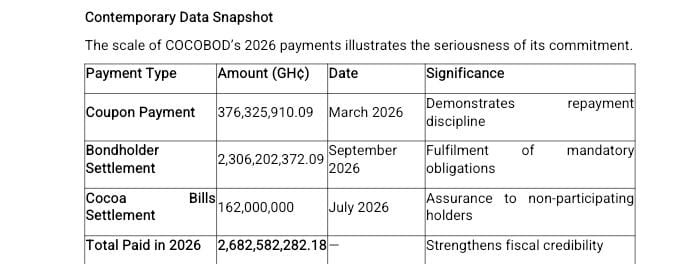
Designed to ease the burden of unsustainable debt, the programme exchanges existing bonds for new instruments with longer maturities and reduced coupons. The Ghana Cocoa Board (COCOBOD), a critical institution in the country’s financial and agricultural ecosystem, has now completed its 2026 payment obligations under the DDEP, totalling GH¢2.68 billion. This achievement is not only a technical fulfilment of obligations but also a symbolic statement of fiscal discipline, credibility and resilience.
This article explores the historical antecedence of Ghana’s debt restructuring, COCOBOD’s role in stabilising the economy, the contemporary impact of the DDEP, and the promise of a brighter future for government initiatives, businesses, investors and households.
Historical antecedent
Debt restructuring has been a recurring theme in Ghana’s economic history.
1. 1960s debt crisis: External debt surged to US$700 million while reserves collapsed to US$14 million, forcing rescheduling.
2. 1980s arrears: Arrears reached US$580 million, necessitating the Economic Recovery Programme.
3. 2000s debt burden: Debt soared to 557 per cent of government revenue, leading to relief under the Highly Indebted Poor Countries (HIPC) Initiative.
4. 2020s debt distress: COVID-19 shocks and global tightening pushed debt above 90 per cent of GDP, making the DDEP inevitable.
COCOBOD has historically played a stabilising role in these cycles. In past debt crises, the Board ensured that cocoa-backed loans and bills were honoured, even when government finances faltered. This consistency reassured both domestic and international investors that Ghana’s most important export commodity remained a reliable anchor. The 2026 payments continue this tradition, demonstrating that COCOBOD remains a pillar of credibility in turbulent times.
This comes against the backdrop of Ghana’s public debt stock of GH¢719.5 billion in June 2026, domestic debt of GH¢391.1 billion, inflation at 4.6 per cent in July, GDP growth of 6.4 per cent in the first quarter, and foreign reserves of US$7.8 billion covering 4.2 months of imports.
Impact assessment
Government initiatives
1. Infrastructure financing: Timely payments enhance credibility, enabling government to attract private partners for industrial parks, energy projects and transport systems.
2. 24 Hour Economy policy: Investor confidence in sovereign risk supports the rollout of this initiative.
3. Export expansion: Stable debt management underpins agro-processing, tourism and digital services.
4. Tax mobilisation: With debt service discipline, government can focus on efficiency rather than emergency borrowing.
Businesses
1. Liquidity release: Banks can lend more to businesses when sovereign borrowing needs decline.
2. Lower cost of capital: Declining inflation and interest rates improve investment planning.
3. Sectoral growth: Agribusiness, logistics, pharmaceuticals and technology benefit from stable financing.
4. Public-private partnerships: Businesses gain confidence in government contracts.
Investors
1. Diversification opportunities: Productive sectors such as renewable energy and manufacturing offer stronger returns than sovereign bonds.
2. Foreign exchange generation: Export-oriented investments reduce exposure to cedi depreciation.
3. Private credit and SME finance: Infrastructure funds and guarantees channel liquidity into growth.
4. Risk premiums: Credible DDEP payments lower sovereign risk, making Ghana more attractive globally.
Households
1. Stable pensions: Timely payments protect pension fund portfolios.
2. Employment prospects: Growth in agribusiness and manufacturing creates jobs.
3. Purchasing power: Inflation at 4.6 per cent supports consumption.
4. Indirect costs: Households still bear taxation and weakened public services if debt management falters.
Econometric significance
The debt-to-GDP ratio fell from 90 per cent in 2022 to 78 per cent in mid-2026. The cedi stabilised at GH¢11.5 per US dollar in July 2026 compared to GH¢15.2 in late 2022. These indicators suggest that the DDEP, alongside disciplined payments such as COCOBOD’s, has contributed to macroeconomic stability. However, substantial maturities in 2027 and 2028 will test Ghana’s fiscal resilience.
COCOBOD’s past handling
COCOBOD has a long record of managing debt obligations responsibly.
1. In the 1980s, despite arrears in government accounts, COCOBOD honoured its syndicated loans, ensuring cocoa exports remained uninterrupted.
2. In the 2000s, during the HIPC era, COCOBOD maintained payments on cocoa bills, protecting investor confidence.
3. In the 2010s, when fiscal deficits widened, COCOBOD’s cocoa-backed loans provided a buffer for foreign exchange inflows.
4. In the 2020s, during the COVID-19 pandemic, COCOBOD prioritised debt servicing to sustain cocoa farmer incomes and maintain credibility.
This track record demonstrates that COCOBOD has consistently acted as a stabiliser, ensuring that Ghana’s most important export commodity remains a reliable source of fiscal and financial stability.
Brighter future
The completion of the 2026 payments under the DDEP is not only a demonstration of fiscal discipline but also a promise of a brighter future.
1. For government: Credibility in debt servicing will attract cheaper financing for infrastructure and social programmes.
2. For businesses: Lower borrowing costs and stable macroeconomic conditions will support expansion and innovation.
3. For investors: Reduced risk premiums will make Ghana a more attractive destination for capital.
4. For households: Stable pensions, job creation and controlled inflation will improve welfare.
COCOBOD’s commitment signals that Ghana can restructure debt while protecting households, businesses and investors. The lesson from history is clear. Restructuring buys breathing space, but only fiscal discipline, productivity and sustained growth can secure lasting debt sustainability. If Ghana leverages this renewed confidence, the future will be one of stronger businesses, resilient households and sustainable infrastructure, with cocoa once again at the heart of national prosperity.
Conclusion
COCOBOD’s settlement of GH¢2.68 billion under the DDEP is more than a financial transaction. It is a continuation of its historical role as a stabiliser in Ghana’s debt cycles and a promise of a brighter future. By honouring obligations, COCOBOD reinforces trust in the financial system and signals that Ghana can restructure debt while protecting households, businesses, and investors. The challenge ahead is to convert restored confidence into cheaper capital, stronger businesses, resilient households, and sustainable infrastructure.
Ghana’s debt history shows that crises are cyclical, but institutions like COCOBOD provide continuity and credibility. The brighter future promised by the DDEP will depend on sustained fiscal discipline, productivity growth, and the resilience of households and businesses. Cocoa, as Ghana’s most important export, will remain central to this journey, anchoring the country’s economic renewal and fiscal credibility.